ISO 9001 software
for your QMS
Run your quality management system to ISO 9001:2026 on one set of data: processes and their interactions, risks and opportunities, quality objectives, documented information, internal audits and corrective actions — from set-up to recertification, with consulting as you need it.
- 01ISO 9001:2026 requirements catalogue — clauses 4 to 10, each requirement assessed on its own
- 02Process map, owners and interactions as linked objects
- 03Risks and opportunities, quality objectives and actions with deadlines and status
- 04Internal audits, nonconformities and corrective actions, fully traceable
- 05One integrated management system with ISO 27001, NIS2, GDPR and other standards
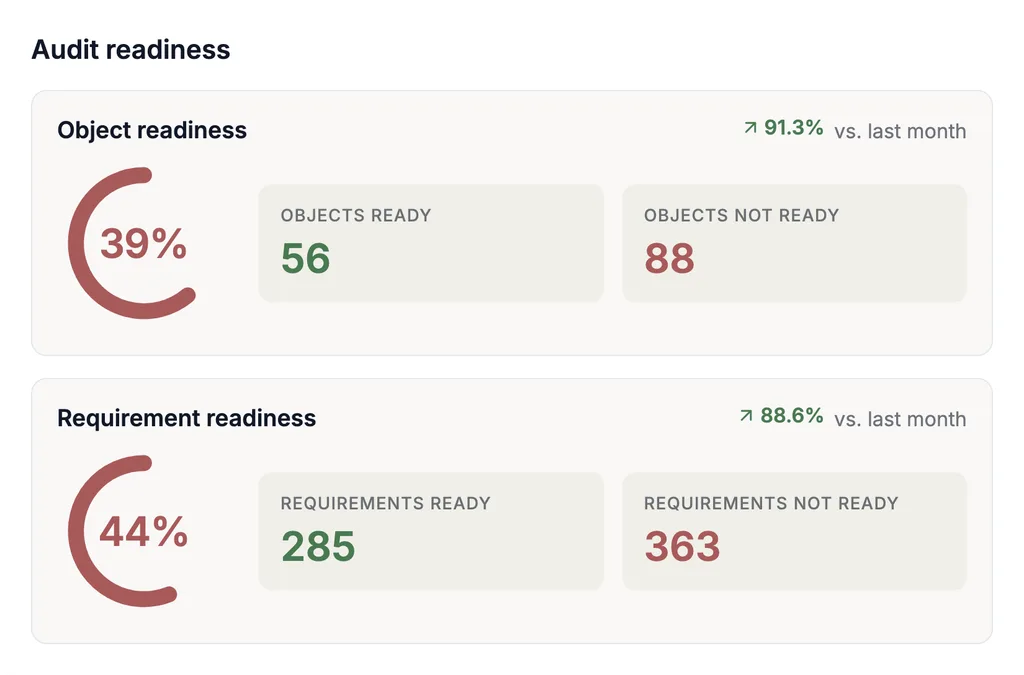
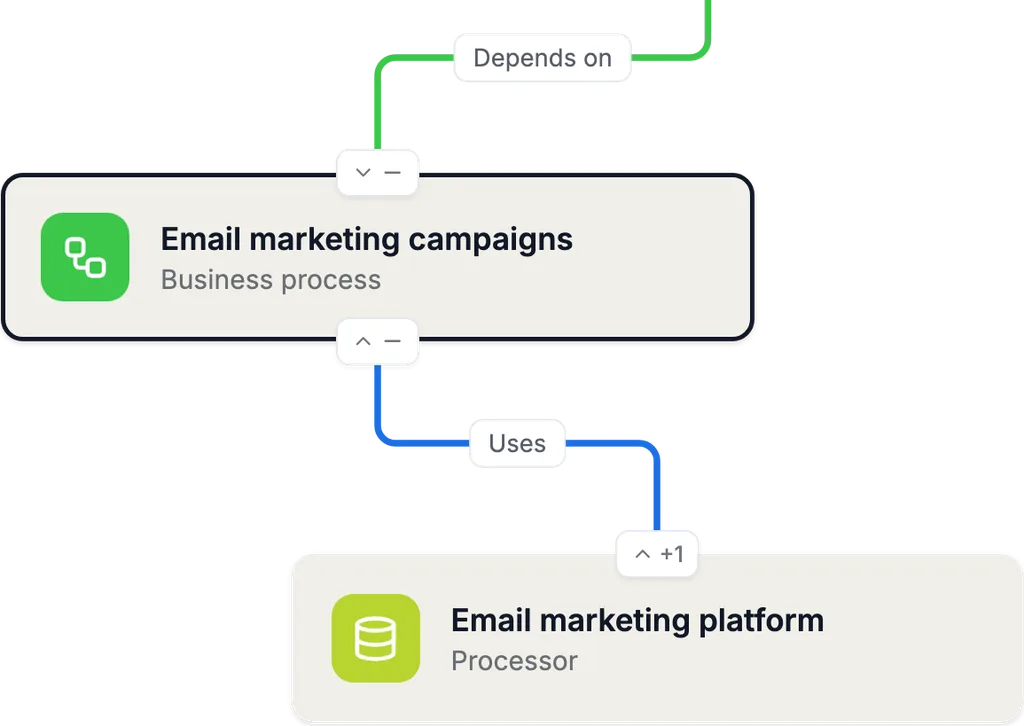
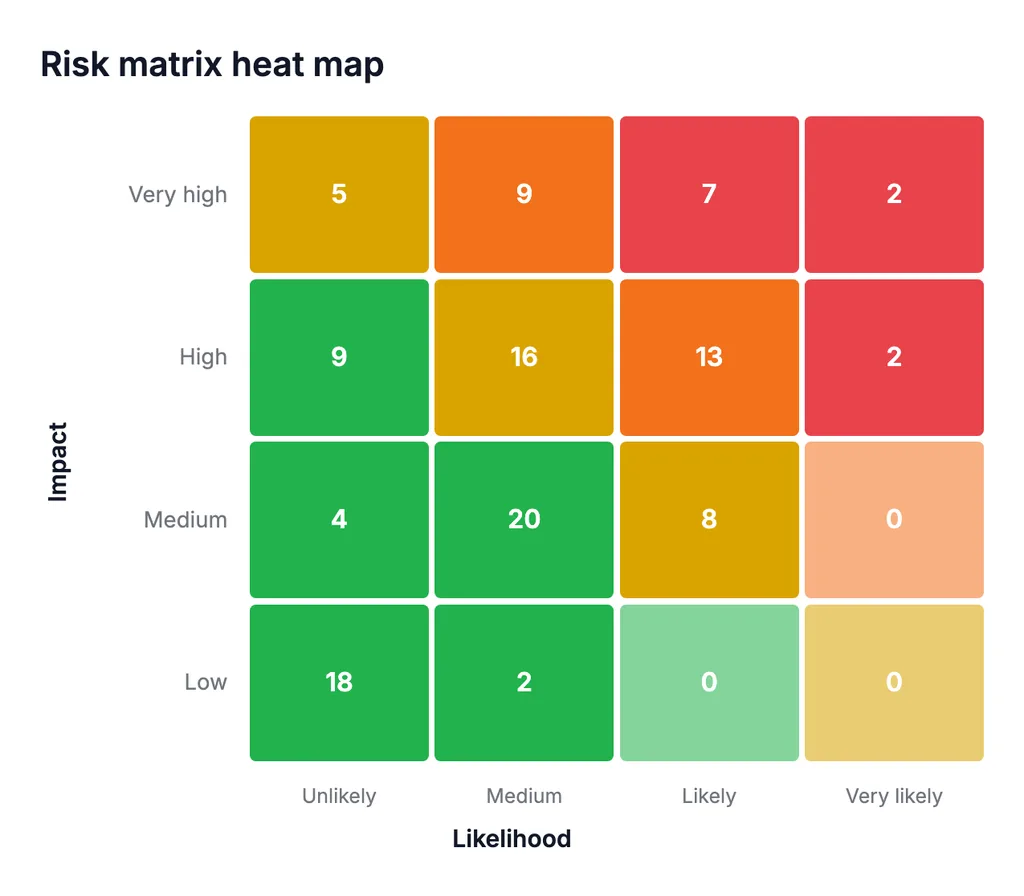
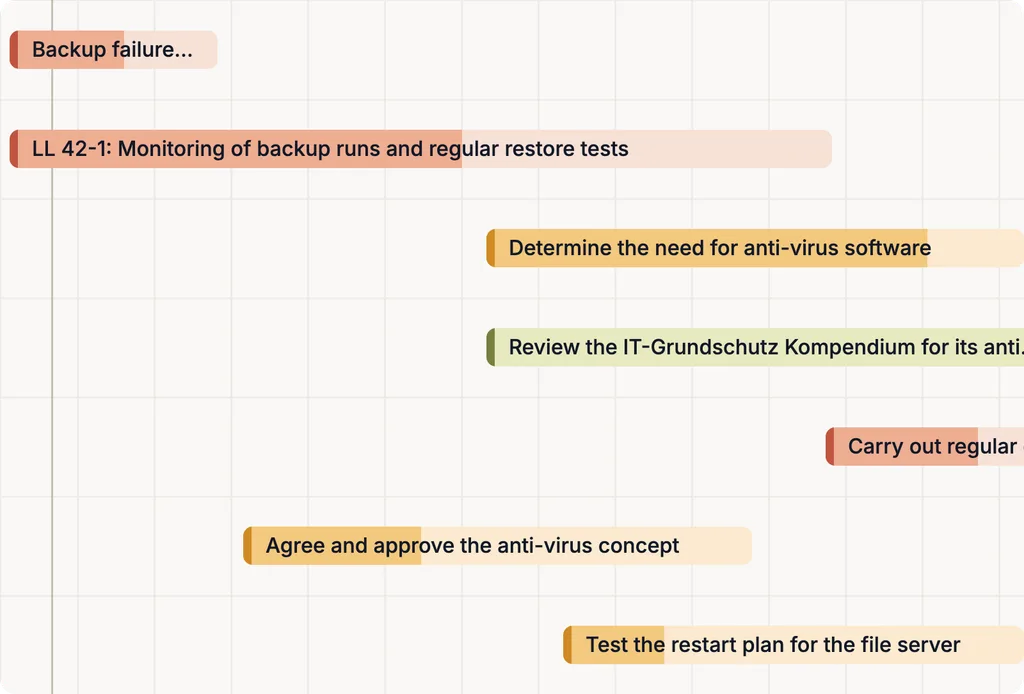
Build, run and improve a QMS to ISO 9001
The functions with which Complaica ISO 9001 software covers the quality management system — from the process map through risks, objectives and documented information to the internal audit and the management review.
- 01ISO 9001:2026 requirements catalogue with every clause from 4 to 10 — each requirement with status, owners, documents and notes
- 02Process map: management, core and support processes with owners, inputs, outputs and interactions
- 03Context of the organization: internal and external issues, interested parties and their requirements, the scope of the QMS
- 04Assess risks and opportunities per process in configurable matrices and link them to actions
- 05Track quality objectives with owners, dates and status
- 06Documented information on the object — quality policy, procedures, records; every change traceable with author and date
- 07Plan and carry out internal audits, record findings and turn them into corrective actions
- 08Nonconformities, complaints and corrective actions with root-cause analysis, deadlines and effectiveness review
- 09Record, evaluate and monitor suppliers and external providers
- 10Reports and dashboards for the management review — from the data, not from slides
- 11Integration with Microsoft Azure, SAP, Jira and other systems; import from and export to Excel
- 12AI integration (MCP) for questions on ISO 9001, on requirements and evidence, and on using the product
ISO 9001 requirements — clauses 4 to 10
ISO 9001 follows the harmonized structure of the ISO management system standards — the same as ISO 27001. The requirements are in clauses 4 to 10; for each, here is what Complaica keeps for it.
Scope and terms
Scope, normative references and terms — the terms and the seven quality management principles are in ISO 9000. These clauses hold no requirements yet.
In Complaica: the catalogue with an explanation of every requirement and the terms it rests on.
Context of the organization
Internal and external issues, interested parties and their requirements, the scope of the QMS and its processes with their interactions. Since the 2024 amendment, whether climate change is a relevant issue is explicitly part of it.
In Complaica: organization, sites, interested parties and processes as linked objects; the scope of the QMS as the scope.
Leadership
Top management takes accountability for the QMS, ensures customer focus, sets the quality policy and assigns roles and authorities. The 2026 edition explicitly asks it to promote a quality culture and ethical behaviour.
In Complaica: the quality policy as a document on the object; roles and responsibilities per process and per object.
Planning
Actions to address risks and actions to address opportunities — treated separately in the 2026 edition —, quality objectives and planning to achieve them, and planning of changes.
In Complaica: risks and opportunities per process in the risk matrix; quality objectives and actions with owners, deadlines and status.
Support
Resources, infrastructure, monitoring and measuring resources, organizational knowledge, competence, awareness, communication and documented information — created, updated and controlled.
In Complaica: documented information with the author and date of every change, training and evidence of competence, knowledge in one searchable store.
Operation
Operational planning and control, requirements for products and services, design and development, control of externally provided processes, production and service provision, release, and control of nonconforming outputs.
In Complaica: processes with inputs, outputs and indicators, supplier evaluation, nonconforming outputs as records with their own workflow.
Performance evaluation
Monitoring, measurement, analysis and evaluation, customer satisfaction, internal audit to an audit programme, and the management review with defined inputs and outputs.
In Complaica: the audit programme and its findings, dashboards for the level of fulfilment, reports as input to the management review.
Improvement
Nonconformity and corrective action — determine causes, implement actions, review effectiveness — and continual improvement of the suitability, adequacy and effectiveness of the QMS.
In Complaica: corrective actions with root-cause analysis, deadlines and effectiveness review; the PDCA cycle on one set of data.
ISO 9001:2026: what changes
The sixth edition of ISO 9001 was published on 16 September 2026 and replaces ISO 9001:2015. The structure of clauses 4 to 10 stays; what has changed is clarity and emphasis.
- Quality culture and leadership
Top management is to promote a quality culture and ethical behaviour — implicit until now, an explicit requirement from this edition.
- Risks and opportunities apart
Actions to address risks and actions to address opportunities are planned separately, instead of in one shared requirement.
- Climate change and context
The climate addition from the 2024 amendment is part of the standard: whether climate change is a relevant issue is assessed with the context and the interested parties.
- Transition dates
From 31 March 2028, initial accredited certifications are issued to ISO 9001:2026 only; certificates to ISO 9001:2015 must have transitioned by 30 September 2029.
- The catalogue in Complaica
Complaica updates its catalogues with new editions of a standard; existing assessments and evidence are kept, and the differences between editions become visible.
ISO information as of 9 October 2026
From a quality manual in Word and Excel to a central QMS
A QMS can be run in documents and spreadsheets — until processes, audits, corrective actions and a second standard start referring to each other. Four points where Complaica organises the work differently.
| Word and Excel | Complaica | |
|---|---|---|
| Processes and interactions | A process map as a drawing, process descriptions as separate files. | Processes as objects with owners, inputs, outputs and dependencies — a change shows wherever the process is used. |
| Audits and corrective actions | Audit reports as documents, actions in a list, chased by hand. | Findings become corrective actions with owners, deadlines and status; every change is recorded with author and date. |
| Evidence for requirements | Links to files in shared folders. | Documents, links and assessments sit on the object and are assigned to the requirement — the way the auditor wants to see them. |
| Several management systems | One manual per standard, maintained twice. | The same processes, risks, actions and evidence for ISO 9001, ISO 27001, NIS2 or the GDPR — where the content fits. |
Complaica modules for the QMS
Seven modules, one connected data set: organisation, processes, requirements catalogue, risks and opportunities, audits, reports and integrations work on the same objects.
01 / 07 · Organisation management
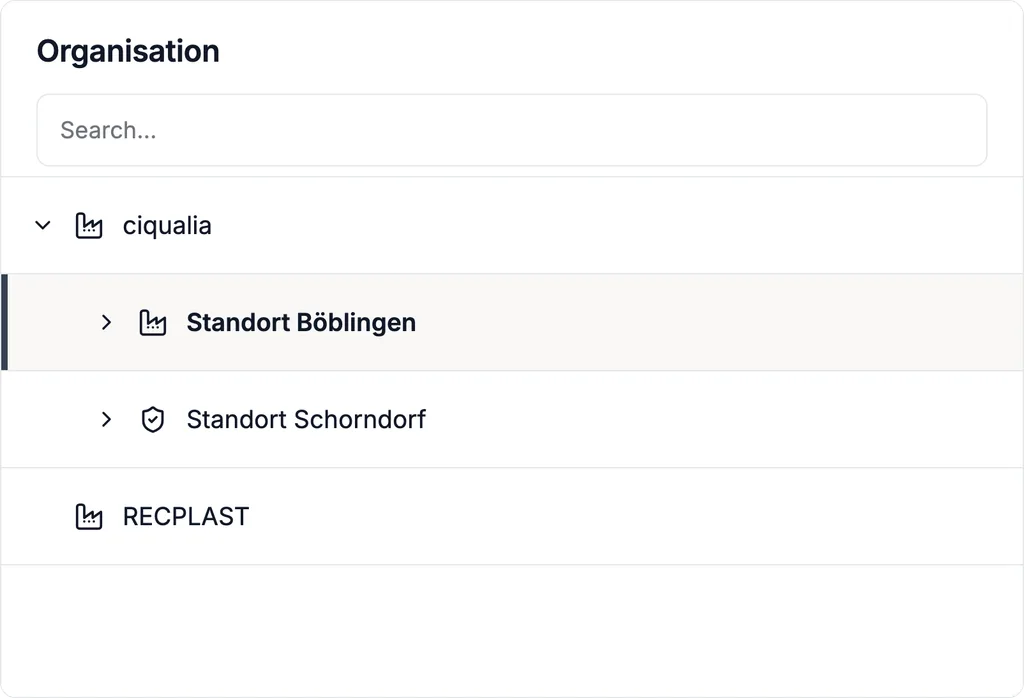
Organisation, sites and scope
Map your organisation as a tree — companies, sites, departments, units — and set what belongs to the scope of the QMS. Responsibilities are assigned per unit and per object; access rights follow the same structure.
02 / 07 · Processes and dependencies
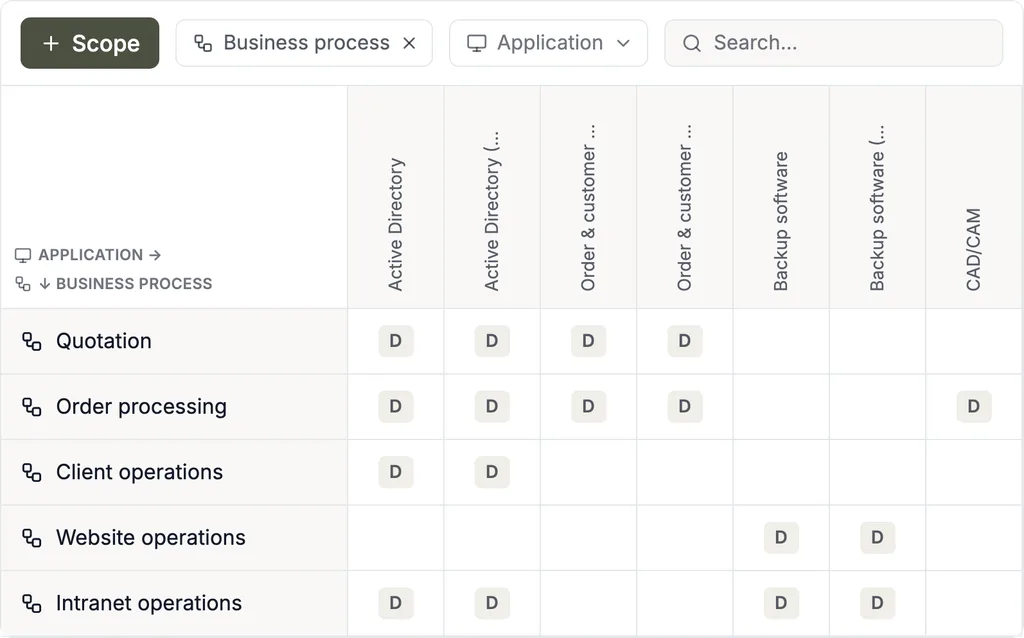
Process map and interactions
Record management, core and support processes with owners, inputs and outputs, and link them to the applications, sites, suppliers and documents they depend on.
Dependency graphs and matrices show the interactions ISO 9001 asks for in clause 4.4 — and which process is affected when a supplier, a system or a rule changes.
03 / 07 · Compliance management
ISO 9001:2026 requirements catalogue
Assess every requirement of clauses 4 to 10 — implemented, partly implemented, open — with owners, documents, tasks and notes. The level of fulfilment rolls up to subclause, clause and overall status.
Your own rules — the organisation manual, customer requirements, sector rules — are assessed on the same model. What is documented for ISO 27001 can be used for ISO 9001 where the content fits.
04 / 07 · Risk management
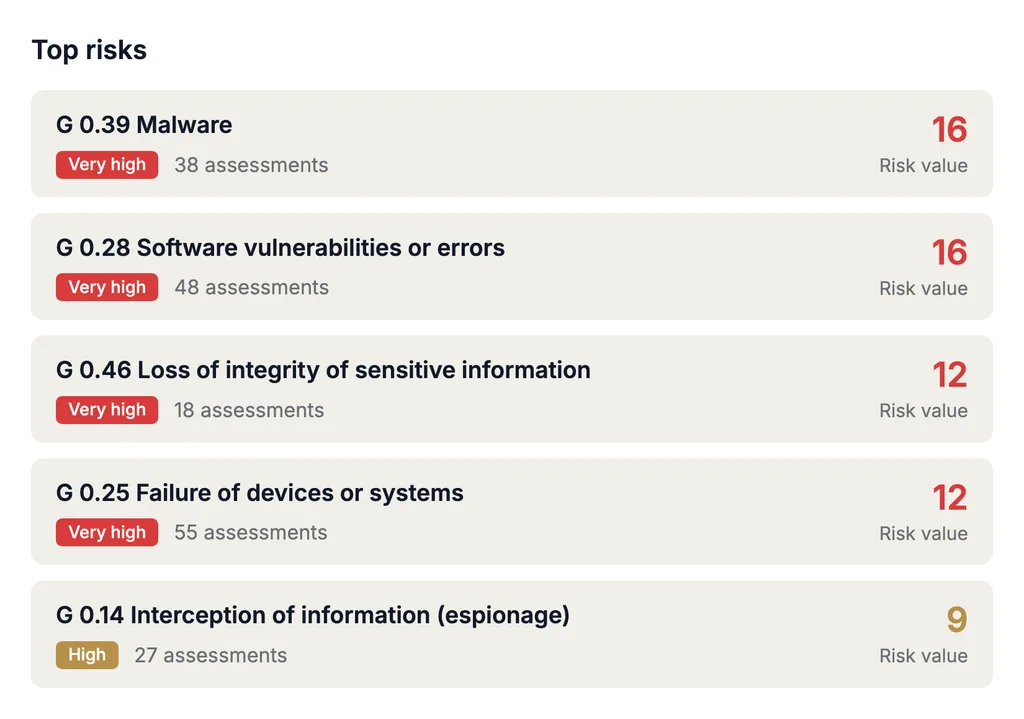
Assess risks and opportunities
ISO 9001 asks for risk-based thinking: identify risks and opportunities per process, assess likelihood and impact in a configurable matrix and link them to actions. Residual risks and opportunities taken are tracked over time.
05 / 07 · Reporting & data analysis
Reports for the management review and the audit
Generate reports on the level of fulfilment per clause, on audit findings, corrective actions and quality objectives from your own data — as a report template or a custom report. Dashboards show management where things stand before the review; external BI tools read the data through the REST API or data marts.
06 / 07 · Task management & collaboration
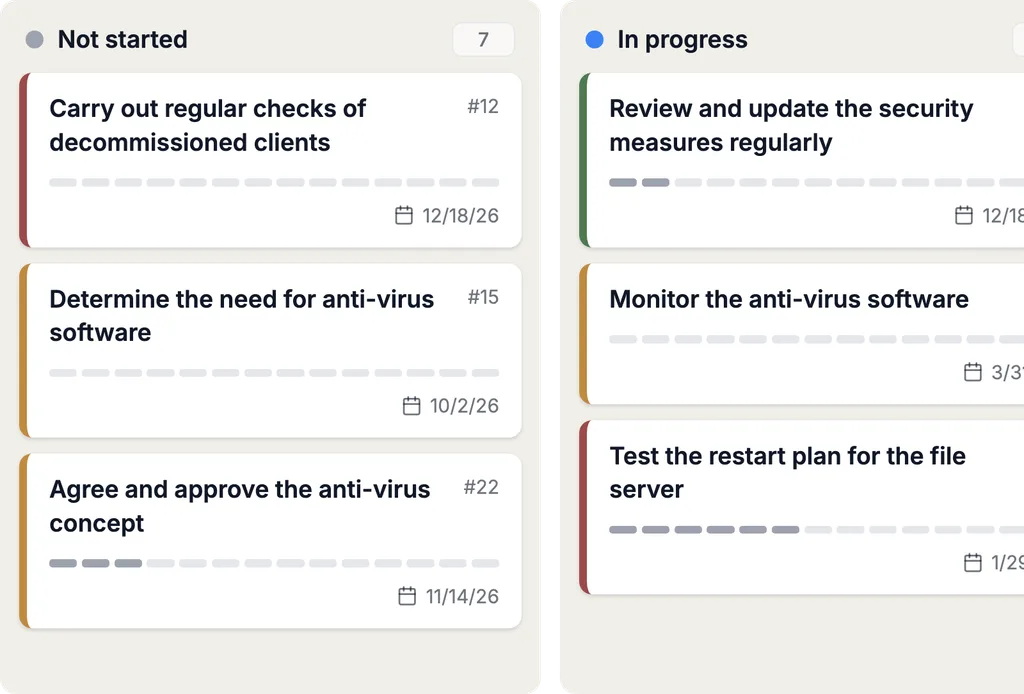
Audits, corrective actions and deadlines
Internal audits, nonconformities, complaints and corrective actions carry owners, deadlines and status; every status change is recorded with author and date. Internal and external participants — auditors or suppliers, say — work in the same system: access is granted per object and by link.
07 / 07 · Integrations & automation
Complaica integrations
Through its REST API, Complaica connects ERP, asset management and CMDB systems — SAP, Microsoft Azure, i-doit and others — and keeps the processes and resources in the QMS in step with reality. Jira, Microsoft Planner and others can be connected as the task system.
Application data is available to external analysis and reporting systems through preconfigured data marts, the REST API or MCP.
Five steps to ISO 9001 certification
From the scope to recertification — and what Complaica takes on at each step.
- 01
DefineContext and scope
Determine internal and external issues, interested parties, the scope and the processes. In Complaica this becomes the process map with its owners.
- 02
Build
Quality policy, objectives, risks and opportunities, documented information. The gap analysis against the requirements catalogue shows what is still missing.
- 03
CheckInternal audit and management review
Internal audit to the audit programme, findings turned into corrective actions, management review with the reports from Complaica.
- 04
CertifyStage 1 and stage 2
The accredited certification body reviews the documentation (stage 1) and the implementation (stage 2). Evidence and reports come from one set of data.
- 05
ImproveSurveillance and recertification
Annual surveillance audits, recertification after three years. Corrective actions and objectives carry on in Complaica.
Why a QMS to ISO 9001?
What a certified quality management system brings an organisation.
- 01The trust of customers and partners — ISO 9001 is the most widely used quality management standard in the world
- 02A prerequisite in many tenders and supplier approvals
- 03Clear processes and responsibilities instead of knowledge held in single heads
- 04Fewer errors, less rework and fewer complaints through corrective actions with an effectiveness review
- 05Decisions based on data — objectives, indicators, audit results
- 06Continual improvement as a fixed cycle, not a project
- 07A foundation for an integrated management system with information security, environment and occupational health and safety
Why Complaica as ISO 9001 software?
Six reasons organisations run their quality management with Complaica.
Processes, not documents
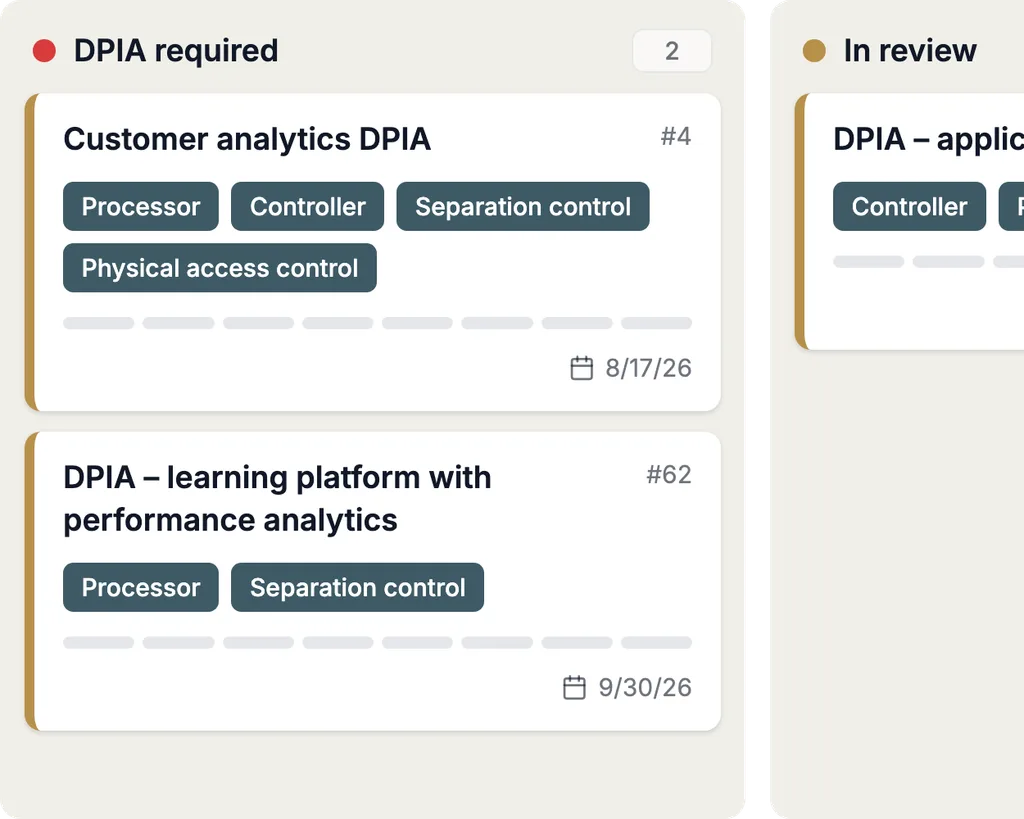
A process is an object with owners, dependencies, risks and evidence — not a file that is sent round again after every change.
Granular requirements
Each ISO 9001 requirement is assessed on its own and linked to documents, tasks and owners. You see where the QMS stands — per clause and per process.
PDCA cycle included
Plan, do, check, act: audits, corrective actions and the management review run on the same data — from the initial certification to recertification.
Consulting from one source
Our consultants support the set-up, the internal audit and certification, and walk you through every function of the product.
Traceable for the auditor
Every change is recorded with author and date; evidence sits on the requirement it proves.
Streamline compliance tasks with AI assistance
With the optional AI integration (MCP), Complaica answers questions on ISO 9001, explains requirements, helps with corrective actions and tasks, and finds answers in your own procedures and documents. It supports the work on the QMS — assessment and decisions stay with you.
- 01Answer questions on ISO 9001 and the 2026 edition
- 02Explain requirements — what is asked for and what counts as evidence
- 03Suggest, word and assign corrective actions and tasks
- 04Evaluate your procedures, process descriptions and documents and answer questions on them
- 05Explain how to use Complaica — which function is for what
What customers say about Complaica
“We can do everything we need in one tool”
Complaica is extremely user-friendly and customising it is child’s play. We can take care of ISO compliance and data protection with it — we can do everything we need in one tool. For us, Complaica is better than the alternatives on the market and cheaper at the same time.
More …Less
Complaica is extremely user-friendly and customising it is child’s play. We can take care of ISO compliance and data protection with it — we can do everything we need in one tool.
For us, Complaica is better than the alternatives on the market and cheaper at the same time.
“The optimised compliance process”
One of the features we like best about Complaica is the optimised compliance process. The user interface has a clear, structured design that offers more usability and encourages a higher working speed. This not only gives new users a steep learning curve, it also lets experienced users minimise their effort. In every phase of the security management lifecycle, recurring tasks such as scoping, structure analysis, modelling and even the tracking of risks and measures are supported by a wealth of functionality. On top of that the platform’s performance is great — it is stable and excellent in terms of speed.
More …Less
One of the features we like best about Complaica is the optimised compliance process. The user interface has a clear, structured design that offers more usability and encourages a higher working speed. This not only gives new users a steep learning curve, it also lets experienced users minimise their effort.
In every phase of the security management lifecycle, recurring tasks such as scoping, structure analysis, modelling and even the tracking of risks and measures are supported by a wealth of functionality.
On top of that the platform’s performance is great — it is stable and excellent in terms of speed.
“The guided approach played a decisive role for us”
We were new to compliance and to implementing ISO 27001, and had to go through the complicated certification process. Given the regulatory complexity, we wanted to find the best way for us to get started. Our project manager (aka security officer) had never worked with such compliance standards and rules before. So we decided on support from a third party — Complaica, to be precise. The guided approach played a decisive role for us. Complaica had all the detailed explanations for the compliance check and the risk analysis, including practical suggestions.
More …Less
We were new to compliance and to implementing ISO 27001, and had to go through the complicated certification process.
Given the regulatory complexity, we wanted to find the best way for us to get started. Our project manager (aka security officer) had never worked with such compliance standards and rules before.
So we decided on support from a third party — Complaica, to be precise. The guided approach played a decisive role for us. Complaica had all the detailed explanations for the compliance check and the risk analysis, including practical suggestions.
ISO 9001 consulting
Consulting along the QMS — from the scope to recertification, as much as you need.
- Gap analysis
Your current state against the requirements of ISO 9001:2026. Result: the level of fulfilment per clause, a prioritised list of gaps and an implementation plan.
- Transition to ISO 9001:2026
For certified organisations: assess the changes of the new edition, adapt the documentation, prepare the transition in the surveillance or recertification audit.
- Setting up the QMS
Context, process map, roles and documented information are set up in Complaica. You get a working QMS.
- Internal audits
Set up the audit programme, carry out or accompany internal audits, turn findings into corrective actions.
- Preparing for certification
Prepare stage 1 and stage 2, provide evidence the way the auditor wants to see it, support the management review.
- Integrated management system
Connect ISO 9001 with ISO 27001, NIS2 or data protection on one set of data — shared processes, risks and audits.
SaaS or on-premises
Complaica runs where your organisation needs it — the licence costs the same either way.
- SaaS, hosted in Germany
The SaaS edition is operated in Germany; you work in the browser, with no infrastructure of your own.
- On-premises in your infrastructure
You run Complaica in your own environment — for organisations whose data may not leave the house.
- Bring your existing data
Import and export from and to Excel and through the REST API; our specialists support the move of your data free of charge.
ISO 9001 in an integrated management system
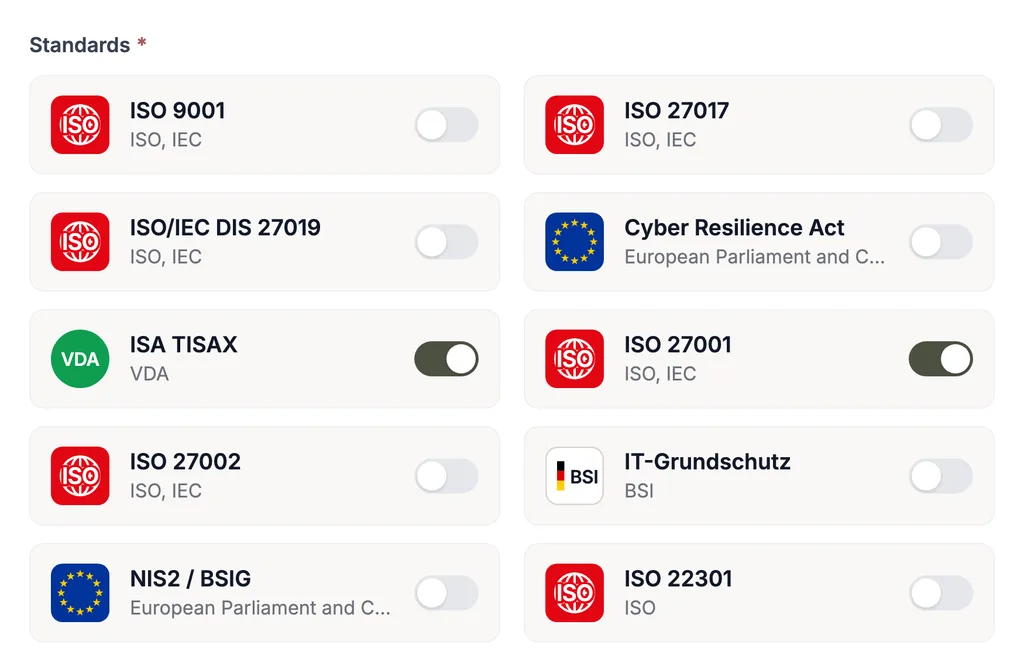
ISO 9001 shares the harmonized structure with the other ISO management system standards. In Complaica their requirements use the same processes, risks, actions and evidence: what is documented for the QMS can be used, where the content fits, for an ISMS to ISO 27001, for NIS2, TISAX or data protection management under the GDPR.
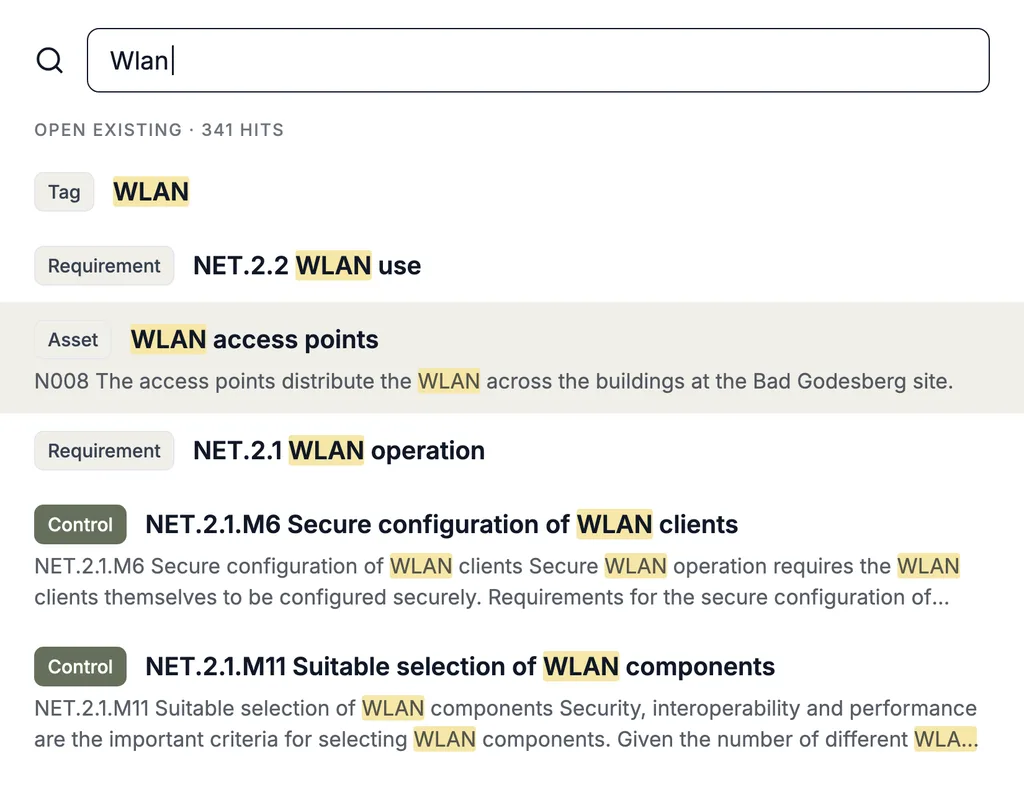
Every standard ships with its requirements catalogue; your own catalogues can be added at any time.
Frequently asked questions about ISO 9001 software
What is ISO 9001?
ISO 9001 is the international standard for quality management systems (QMS). It sets the requirements with which an organisation shows that it consistently delivers products and services the way customers and the law require, and that it continually improves its QMS. Within the ISO 9000 family, ISO 9001 is the only standard that can be certified to.
What is new in ISO 9001:2026?
The sixth edition was published on 16 September 2026. The structure of clauses 4 to 10 stays; the standard is worded more clearly, stresses quality culture, ethical behaviour and leadership, treats risks and opportunities separately, takes in the 2024 climate amendment and is more closely aligned with the other ISO management system standards. A new Annex A explains key terms and the intent of the requirements.
When must we transition to ISO 9001:2026?
According to the responsible ISO committee, TC 176, initial accredited certifications are issued to ISO 9001:2026 only from 31 March 2028, and certificates to ISO 9001:2015 must have transitioned by 30 September 2029. The transition usually takes place in a surveillance or recertification audit — agree the date with your certification body.
What is ISO 9001 software?
ISO 9001 software holds the requirements of the standard as a catalogue and connects them to the parts of your QMS — processes, owners, risks and opportunities, objectives, documents, audits and corrective actions. Instead of keeping the manual, process descriptions and action lists apart, you work on one set of data from which the level of fulfilment and the reports follow.
What clauses does ISO 9001 have?
Clauses 1 to 3 hold the scope, normative references and terms. The requirements are in clauses 4 to 10: context of the organization, leadership, planning, support, operation, performance evaluation and improvement. ISO 9001 shares this harmonized structure with ISO 27001, ISO 14001, ISO 45001 and other management system standards.
How does Complaica support internal audits?
You plan the audit programme, carry out audits per process or requirement and record findings on the object. Nonconformities become corrective actions with owners, deadlines, root-cause analysis and an effectiveness review. Reports and dashboards summarise the results for the management review.
Can Complaica run ISO 9001 and ISO 27001 together?
Yes. Both follow the harmonized structure; in Complaica they use the same processes, risks, actions and evidence. Context, leadership, documented information, internal audit and management review are kept once and used for both standards where the content fits — and the same goes for NIS2, TISAX or the GDPR.
Is ISO 9001 certification mandatory?
No. ISO 9001 is a voluntary standard. In practice, many customers, tenders and sectors require a certificate as a condition of doing business; certification is carried out by an accredited certification body and is valid for three years, with annual surveillance audits.
How long does it take to implement a QMS to ISO 9001?
Six to twelve months to certification is typical — depending on size, number of sites, existing processes and resources. A ready requirements catalogue, the process map as objects and evidence on the object shorten the preparation.
Can an existing quality manual be brought over?
Yes. Complaica imports and exports data from and to Excel and through the REST API; documents are filed on the object. Migrating your data is free of charge and supported by our specialists, so you assess the tool on your own state rather than on demo data.
What does ISO 9001 certification cost?
Three parts: the certification body's audit — depending on headcount, sites and complexity —, the annual surveillance audits, and the effort of building and running the QMS (internal time, consulting, software). Complaica lowers the third part. We send a price list on request.
Is Complaica available as SaaS or on-premises?
Both. The SaaS edition is hosted in Germany; on-premises, you run Complaica in your own infrastructure. The licence costs the same either way.
Sources References and legal sources
3 sources · ISO 9001, ISO/TC 176, ISO/IEC 27001 Show Hide
Norms & standards
Guidelines & official publications
Only the version published in the respective official journal is legally binding. Standards are available from the publishers named.
Start ISO 9001 with Complaica
Try Complaica, ask for the price list or talk to us about your existing QMS and a migration — write to us.
Thank you.
We will get back to you within one business day.
Not sent.
That did not work. Please check the fields or email us directly.